
Campus & Community
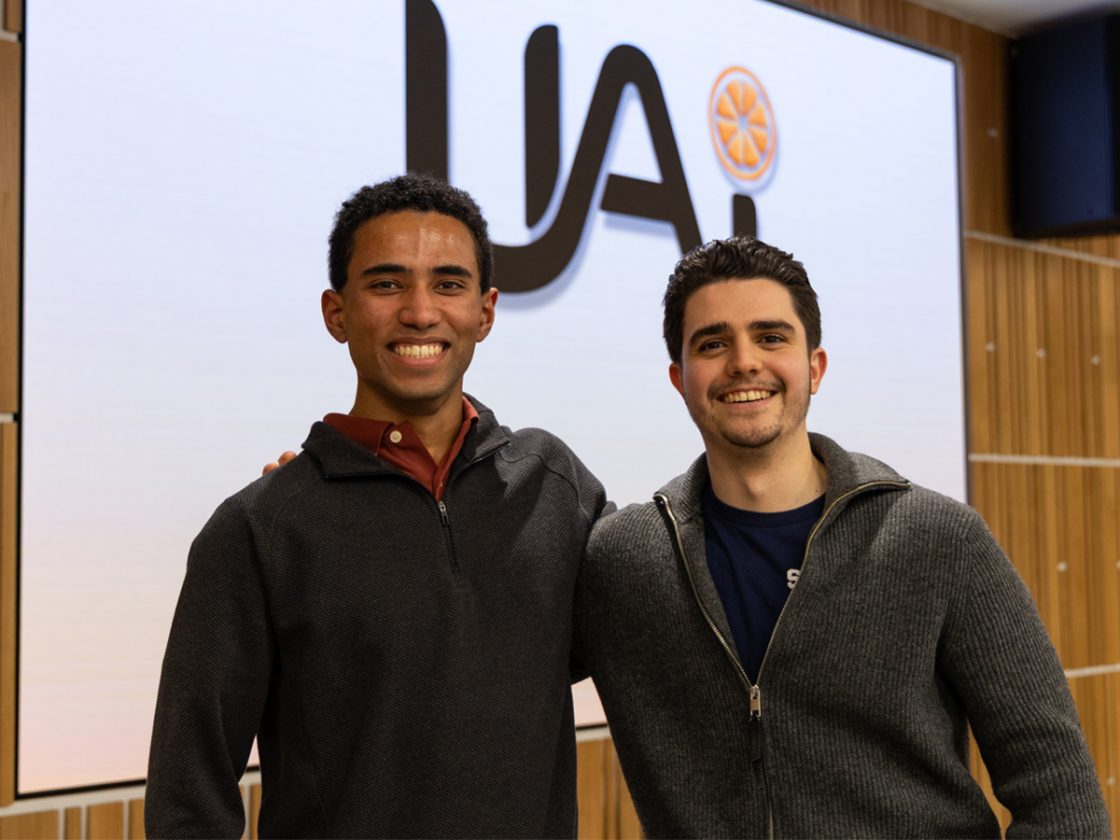
Orion Goodman (left) and Tyler Neary, co-founders of United AI (Photo by Reed Granger)
Students Unite Around AI By Bringing Diverse Voices to Technology’s Future
When Tyler Neary ’27and Orion Goodman ’27 scattered flyers across campus last spring advertising a new AI club, they saw a critical need: students needed to be included in conversations about a technology that would fundamentally reshape their futures.
“AI was at the point where it could help people in every single major, in every single profession, in every single job,” says Neary, a civil engineering major who co-founded United AI with Goodman, a biomedical engineering major, both in the College of Engineering and Computer Science (ECS). “We realized this was no longer just a computer science thing.”
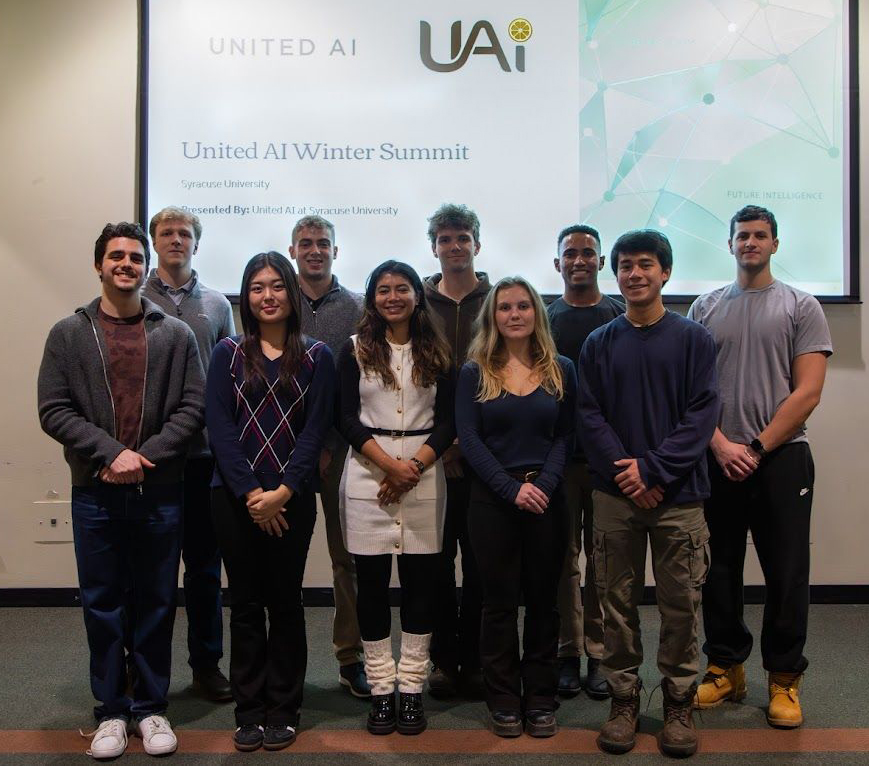
What started as a room of 10 people has grown into United AI, a recognized student organization (RSO) with more than 100 members representing every single school and college and most majors. Since its fall semester launch, the club’s focus has been democratizing AI literacy and ensuring students from all disciplines have a seat at the table as this technology transforms society.
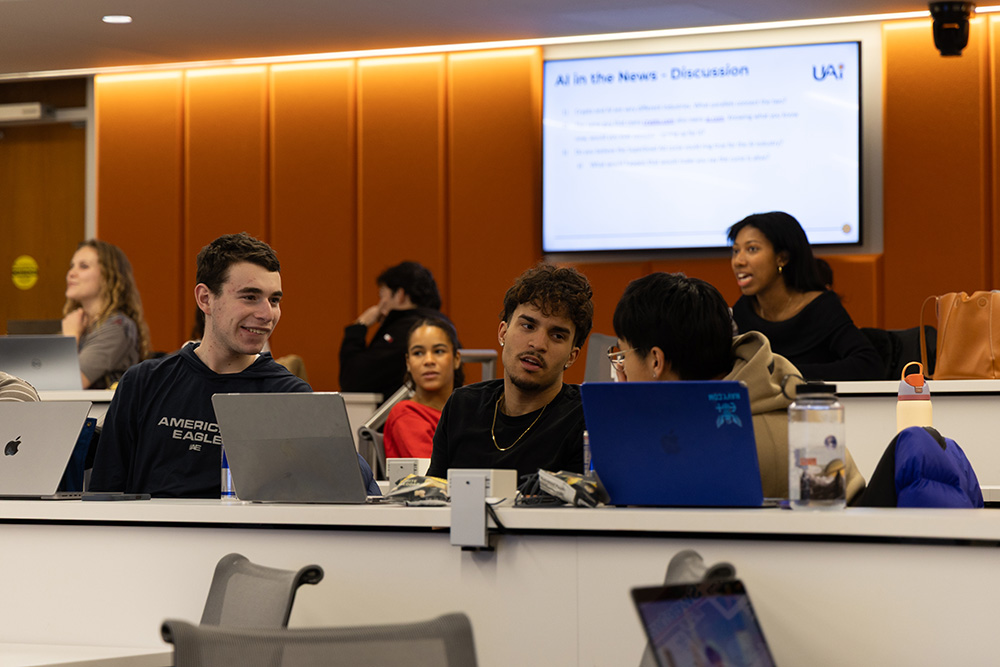
The group will host a Universitywide AI Summit on Saturday, April 25, from 1 to 5 p.m. in the K.G. Tan Auditorium in the National Veterans Resource Center at the Daniel and Gayle D’Aniello Building, featuring industry speakers, demonstrations and faculty research showcases.
Why Students Need Leadership in AI Development
For Goodman, the urgency became clear watching rapid AI development. “When I’m going through college, watching AI capabilities escalate, it can be disempowering—and I figured my peers may be feeling the same way,” he says. “It felt threatening because there’s a small group of people making decisions about how the technology is being used, and others feel like they’re being left behind.”
That sense of being sidelined drove the co-founders to create what Neary describes as an empowerment space. “Something that we say a lot in the club is: don’t get used by AI, use AI to your benefit,” he says. “We’re the ones who are going into the workforce leading the charge and determining how we will use this technology now and into the future.”
The message resonated. Within weeks of tabling at campus events, students from ECS, the Maxwell School of Citizenship and Public Affairs, the College of Arts and Sciences, the Newhouse School of Public Communications, the Whitman School of Management and the College of Visual and Performing Arts were showing up to meetings, eager to understand how AI would affect their fields and futures.
Bringing Humanities and STEM Into Conversation
When Alex Kahn ’27, a junior studying citizenship and civic engagement and political philosophy in the Maxwell School | College of Arts and Sciences, discovered United AI, he wasn’t looking for coding or technical skills, but was compelled by the policy implications of AI that were dominating news headlines. “AI was in every story, across every industry, and it felt like there was no escaping it and how it will affect you,” Kahn says.
As United AI’s recruitment director last fall, Kahn became instrumental in broadening the organization beyond its engineering roots. His approach focused on relevance rather than technical expertise. The interdisciplinary composition has transformed conversations within the club.
“Having people from different majors and disciplines means having that understanding that everyone’s mind works differently,” Kahn says. “The people who are writing code are not thinking the same way as the person majoring in fine arts, and having that creativity along with those technical skills, you’re able to build and think much differently.”
Goodman appreciates what non-engineering perspectives bring to the table. “As conversations around AI progressed, I began asking, ‘Where are the artists? Where are the policymakers? Where are the humanities majors?’” he says. “A lot of the population was not behind building this technology and still isn’t—but how do we provide a space for them to learn and join the conversation?”
From Concept to Creation: Student Projects Take Shape
United AI goes beyond theoretical discussion to hands-on application. Through four-week project cycles, students receive funding, access to premium AI tools and mentorship to develop their ideas.
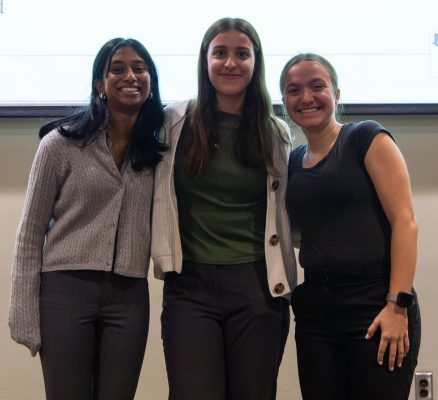
Paige Siciliano ’29, a computer engineering major, led a second-place winning project during her first semester on campus. Her team’s AI-powered schedule builder, still under development, helps students manage their time by generating personalized daily plans based on individual learning styles, fixed commitments and flexible tasks.
For Siciliano and her teammates—Neha Redda ’29 and Ria Yagielski ’29—the project provided more than AI experience. “It really helped us find a way into the community of Syracuse, and it helped us feel like we belonged,” she says.
Building Community Around Shared Curiosity
Beyond projects and programs, United AI has cultivated what Kahn describes as “a school of thought on campus.” During a debate night last semester, members discussed everything from business applications to environmental impacts to personal usage philosophy, with some participants there simply to understand the technology rather than use it. “Being surrounded by club members and in this community of lifelong learners, we focus our educational efforts to not just learn the technical side, but also on practical application,” Kahn says.
Siciliano emphasizes the club’s welcoming atmosphere. “We came in as first-semester freshmen, two weeks into school. It didn’t matter if we had no background knowledge in AI or all the knowledge in the world—they create an atmosphere that makes you want to learn about it and continue to grow.”
To join United AI, visit the club’s website. To learn more, follow the organization on Instagram or LinkedIn.
The post Students Unite Around AI By Bringing Diverse Voices to Technology’s Future appeared first on Syracuse University Today.